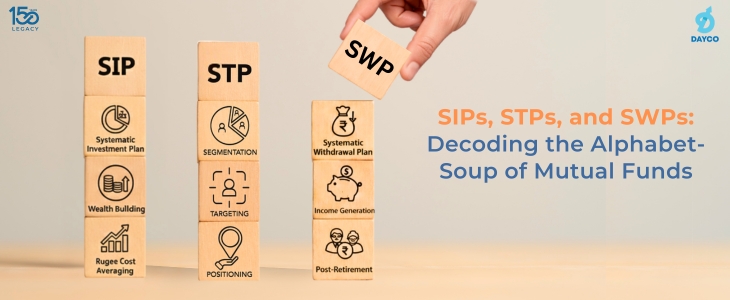
SIP STP and SWPs Decoding the Alphabet Soup of Mutual Funds

December 13, 2025

0 Comments

SIP STP and SWPs Decoding the Alphabet Soup of Mutual Funds
Mutual funds are a great way to grow your wealth. However, they come with a lot of tools and options to choose from that may seem overwhelming to someone who has not invested before. One of the most common terms that confuses new investors is SIP (Systematic Investment Plan), STP (Systematic Transfer Plan) and SWP (Systematic Withdrawal Plan).

These are not just fancy jargon; they are actual instruments that help investors manage and improve their holdings. Understanding these tactics can help you achieve your financial goals, whether you want to gradually increase your wealth, modify your investments over time, or remove money in a systematic manner.

For example, say you wish to start investing in mutual funds after landing your ideal job. You had chosen to invest according to your risk tolerance, but all of a sudden you hear terms like SIP, STP, SWP, and Switch, and you're not sure what you might be missing if you don't learn about them.

To make these terms easier to understand, let's read about how each of these three tools works and how you can use them to reach your financial goals.

Systematic Investment Plans

A Systematic Investment Plan (SIP) means investing a fixed amount regularly, usually every month or quarter, into a mutual fund. It encourages financial discipline and instills a long-term investing habit. SIPs allow you to invest small amounts periodically, which can grow into a large corpus over time through the power of compounding.

SIPs help you avoid the stress of timing the market by investing a fixed amount at regular intervals, regardless of market movements. This disciplined approach, known as rupee cost averaging, ensures you buy more units during market lows and fewer when prices are high, thereby averaging the purchase cost over time, reducing the impact of volatility, and minimizing the risk of poor market timing—making SIPs especially effective for long-term, goal-based investments.

Key Features of an SIP

Below are some of the features of SIP:

● Regular and automatic investing: Fixed contributions at regular intervals (monthly, quarterly, etc.) through auto-debit.
● Flexibility: You can start with as low as ₹500 per month and increase your SIP later through a step-up feature.
● Compounding benefits: Reinvested returns over time help accelerate growth.
● Market-timing advantage: Minimises risk by spreading investment entry points.

SIPs are ideal for salaried professionals, young investors, and anyone looking to build wealth gradually without needing a large initial investment. They’re perfect if you have long-term goals such as retirement, a child’s education, or buying a home.

Systematic Transfer Plan

A Systematic Transfer Plan (STP) allows investors to transfer a fixed amount periodically from one mutual fund (usually a debt or liquid fund) to another (typically an equity fund). In simple terms, it’s like moving money from your “parking lot” (conservative fund) to your “growth vehicle” (riskier fund) in a phased, systematic manner.

STPs are particularly useful when you have a lump sum to invest but want to avoid exposing it to market volatility all at once.

Key Features of Systematic Transfer Plan

● Automated transfers: pre-scheduled movement of funds between two schemes of the same fund house.
● Reduces risk: Eases into equity markets gradually instead of investing the full amount upfront.
● Customisable frequency: Transfers can be monthly, quarterly, or even weekly.
● Better fund management: Idle cash in a liquid or debt fund can earn returns before being transferred.

STPs suit lump-sum investors, retirees, or anyone who wants to shift capital from low-risk to high-risk funds strategically. For example, if you receive a bonus or have large savings, an STP helps you enter equity markets gradually.

Systematic Withdrawal Plan (SWP)

A Systematic Withdrawal Plan (SWP) allows investors to withdraw a fixed amount periodically from their mutual fund investments. Rather than redeeming the entire amount at once, you can set up regular withdrawals—monthly, quarterly, or annually, depending on your income needs.
This makes SWPs an excellent tool for creating a steady income stream, particularly post-retirement.

Key Features of SWP

● Regular income stream: Provides consistent cash flow without liquidating your entire corpus.
● Flexible frequency: Choose withdrawal intervals and amounts based on financial requirements.
● Tax efficiency: Only the withdrawn units are taxed, potentially reducing overall tax liability.
● Wealth preservation: Remaining units continue to stay invested and earn returns.

SWPs are suited for retirees, freelancers, or anyone seeking regular income from investments while maintaining long-term market participation.

SIP vs STP vs SWP: Comparison and Contrast

While SIP, STP, and SWP serve different purposes, they share a common goal — facilitating systematic investment management. Understanding how they differ helps investors use each at the right stage of their financial journey.

What Are the Similarities?

● All three are systematic approaches to investing or withdrawing money in mutual funds.
● They automate transactions, ensuring discipline and consistency.
● They can reduce the effects of market volatility through phased investments or withdrawals.
● Offered by all major mutual fund houses with flexible customisation.

What Are the Major Differences?


Tax Implications for SIP, STP, and SWP


SIPs, STPs, and SWPs may sound complex, but together they form a powerful toolkit to manage investments at different life stages. SIPs help you start and grow wealth, STPs optimise fund transitions, and SWPs facilitate withdrawals with stability.

From earning your first salary to planning retirement, these tools empower you to invest methodically, stay disciplined and achieve long-term financial independence. The key is to match each plan with your individual goals, time horizon and risk appetite, because in mutual funds, it’s not about timing the market, but time in the market that truly matters.

-Nini Prasad

Share With

Leave a Reply

This is a standard alert.

I'm a cool paragraph that lives inside of an even cooler modal. Wins!

This is a standard alert.

I'm a cool paragraph that lives inside of an even cooler modal. Wins!

https://scores.gov.in

Thank You

All your Questions have been recorded


Thank You

All your Questions have been recorded

Please enter your name Please enter valid name
Please enter your Email Id Please enter valid Email Id
Please enter your mobile number Please enter valid mobile number Please enter your mobile number Please enter valid mobile number
Please enter your Email Please enter valid Email

Thank You!


Thank you for your response. We'll get in touch with you at the earlisest for your investment planning needs


NEXT

Thank You!


Thank You for your interest in our Moderate Equity Portfolio. Please find below the credentials to track this portfolio:

User ID: mockmod@daycoindia.com

Password: abcd@1234


Portfolio Tracker

Please Read!


Risk profiling is crucial for identifying and managing potential risks in investment decisions. Please carry out your risk profiling before making any investment decisions.


Complete Risk Assessment Now

Set Your Goal

Please Select an option from below


Set Your Goal

Please Select an option from below


Set your Goal

Please enter your details in the fields provided

Please enter phone number / UGC