
- About Us
- Contact us
-
Download App
Download Mobile Apps


 Book Appointment
Mutual Fund Expense Ratios Explained: A Simple Guide for Investors
 July 3, 2026
 0 Comments
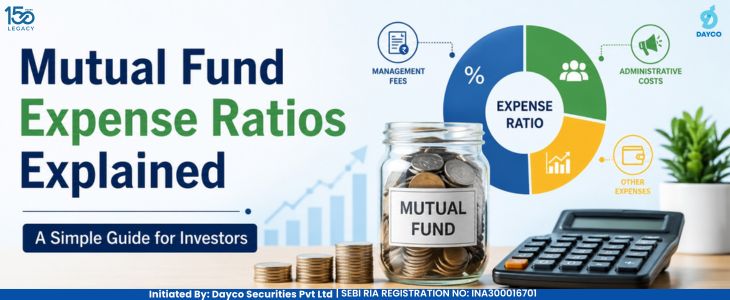
Imagine two investors who each invest ₹10 lakh in different mutual funds. Both funds deliver almost identical returns over the next 20 years.
Yet, one investor ends up with a noticeably larger corpus.
What made the difference?
Not luck. Not market timing. Not stock selection.
The answer is cost.
Most investors spend hours comparing returns, ratings and past performance, but rarely look at what they're actually paying. While these costs may seem small, they quietly reduce your wealth year after year.
With mutual fund folios in India now exceeding 27 crores, understanding investment costs is just as important as understanding returns.
That's where two important concepts come in: the Total Expense Ratio (TER) and the Base Expense Ratio (BER). Understanding these can help you evaluate the true cost of investing and make better-informed investment decisions.
Why Expense Ratios Matter More Than You Think
When investing, returns naturally attract attention. But what you keep is just as important as what you earn.
Even a 0.50% difference in annual expenses can reduce your investment corpus by several lakhs over the long term because costs compound just like returns.
The good news? Unlike market returns, these costs are known before you invest, allowing you to compare funds more effectively.
What is the Total Expense Ratio (TER)?
The Total Expense Ratio (TER) is basically the total annual cost of managing and operating a mutual fund. Just as an apartment building incurs expenses for maintenance, security, administration, and management, a mutual fund also has operating costs. These expenses are expressed as a percentage of the fund's average assets under management (AUM).
Traditionally, TER has included expenses such as:
● Fund management fees
● Registrar and transfer agent fees
● Administrative expenses
● Marketing and distribution expenses
● Custodian charges
● Audit and compliance costs
The important thing to remember is that you never receive a separate bill for these costs. Instead, they are deducted directly from the fund's assets and reflected in its daily Net Asset Value (NAV).
Here’s an example to understand TER better:
Suppose you invest ₹1,00,000 in a mutual fund with a TER of 1.50%. This means the total annual cost works out to ₹1,500. The deduction is made automatically through the NAV, so you don't have to make a separate payment.
While TER reflects the overall cost of investing, BER provides a clearer picture of the fund's intrinsic operational expenses.
What Is the Base Expense Ratio (BER)?
The Base Expense Ratio (BER) is the intrinsic operational expense of running a mutual fund. It may include additional costs permitted under regulatory guidelines. It focuses only on the expenses directly associated with running and managing the scheme, including:
● Investment management fees
● Compliance and regulatory costs
● Basic fund servicing expenses
● Administrative and operational expenses
To Summarise:
BER covers the intrinsic operational costs of managing a mutual fund. This includes fund manager salaries, administrative infrastructure, registrar charges, and distributor pay-outs.
TER, on the other hand, reflects the ultimate cost borne by the investor. It includes the BER plus external, variable pass-through costs such as GST, stamp duty, Securities Transaction Tax (STT), and exchange fees.
Earlier, all these costs were blended together into a single Total Expense Ratio (TER) limit. Under the revised framework, SEBI has decoupled them to bring greater transparency to what goes towards fund management and what goes towards government taxes and trading-related charges. The introduction of BER prevents government taxes and statutory levies from masking or inflating the actual operational and management expenses charged by Asset Management Companies (AMCs).
Understanding the Major Difference Between BER and TER:
Even when two mutual funds have the same TER, their underlying cost structures can differ significantly. Consider the following example:
For example:
● Fund A: BER = 1.50%, Additional Expenses = 0.50%, TER = 2.00%
● Fund B: BER = 1.80%, Additional Expenses = 0.20%, TER = 2.00%
Although both funds have the same TER, Fund A has lower core operating costs. This is something that every investor must keep in mind. Understanding the difference between BER and TER helps investors determine whether higher costs stem from fund management activities or other expenses.
A quick glance at BER vs. TER:

Related Read: Comprehensive Financial Planning: Your Roadmap to Lifelong Freedom
How to Calculate Your True Mutual Fund Cost?
There are various other factors that need to be considered as well. Here's how you can break down the total cost of a mutual fund investment into its key components.
Step 1: Identify the TER
The exact value of the TER can be identified from the mutual fund's factsheet or scheme information document. This value is the total annual expenses charged to investors.
Example:
Investment Amount = INR1,00,000
TER = 1.5%
Annual Expense = INR1,00,000 × 1.5% = INR 1,500
Step 2: Review the BER
Next, you need to review the BER to understand the fund's core operational expenses.
Example:
BER = 1.2%
Base Cost = INR1,00,000 × 1.2% = INR 1,200
This indicates that INR 1,200 of the total expense is spent toward managing and operating the fund.
Step 3: Calculate Additional Charges
Subtract BER from TER to determine the additional expenses.
Additional Expense Ratio = TER – BER
= 1.5% – 1.2%
= 0.3%
Additional Cost = INR1,00,000 × 0.3% = INR 300
This breakdown helps investors understand where their money is being spent.
Do Lower Expense Ratios Always Mean Better Funds?
Not necessarily.
While lower costs are generally beneficial, expense ratio should never be the only factor when selecting a mutual fund. A fund charging slightly higher expenses may still deliver better long-term value if it consistently generates superior risk-adjusted returns.
Before investing, consider:
● Long-term performance consistency
● Risk-adjusted returns
● Investment strategy
● Portfolio quality
● Fund manager's track record
● Expense ratio
The best investment decision balances cost and quality, not cost alone.
What Has Changed Under the New Rules?
To improve expense transparency, the SEBI (Mutual Funds) Regulations, 2026, introduced a revised expense disclosure framework. Under the new framework, statutory levies such as GST, STT, stamp duty and exchange-related charges are recovered separately from the Base Expense Ratio (BER) on an actual basis. This enables investors to distinguish between the AMC's operational expenses and statutory levies, making cost comparisons across mutual fund schemes more meaningful.
The bottom line:
Every investor wants better returns. But successful investing isn't just about how much you earn—it's also about how much you keep. Expense ratios may appear small, but over time, they can have a meaningful impact on your wealth.
The next time you evaluate a mutual fund, don't just ask "What return can this fund generate?"
Also ask,
"What is it going to cost me to earn those returns?"
That simple question could make a meaningful difference to your long-term financial journey.
-Suman Dan & Marifur Rahaman
Share With


 FILED UNDER: Stock Market
I'm a cool paragraph that lives inside of an even cooler modal. Wins!
Are you sure?
In case you didnt know, you can open your account online within 24 hours. Offline account opening takes up to 4 working days. If you wish to open your account offline, fill and sign the forms using a black/blue ballpoint pen. Please fill in the email and mobile number of the applicant to avoid account opening delays.
Enter Password
Please enter your details and password
New to Dayco?
Enter Password
Please enter your details and password
New to Dayco?
Filing Complaints on SCORES (SEBI) – Easy & Quick
- Register on SCORES Portal (SEBI)
- Mandatory details for filing complaints on SCORES:
- Name, PAN, Address, Mobile Number, E-mail ID
- Benifits:
- Effective Communication
- Speedy redressal of the grievances
Thanks !!
Your details were successfully received.

Thank you for Your Feedback!
Our Team is working constantly on improving our user experience and your feedback really means a lot.
Thanks !!
App Link Send to your mobile number successfully.
Thank You
All your Questions have been recorded
Thank You
All your Questions have been recorded
Thank You!
Thank you for your response. We'll get in touch with you at the earlisest for your investment planning needs
NEXT
Thank You!
Thank You for your interest in our Moderate Equity Portfolio. Please find below the credentials to track this portfolio:
User ID: mockmod@daycoindia.com
Password: abcd@1234
Portfolio Tracker
Please Read!
Risk profiling is crucial for identifying and managing potential risks in investment decisions. Please carry out your risk profiling before making any investment decisions.
Complete Risk Assessment Now
Thank You !!
Please enter your details to download/print the report
Thank You !!
Please enter your details to download/print the report
Thank You !!
Please enter your details to download/print the report
Thank You !!
Please enter your details to download/print the report
Thank You !!
Please enter your details to download/print the report


Set Your Goal
Please Select an option from below
Set Your Goal
Please Select an option from below
Thanks You !
We appreciate your interest in our services. Our team will be in touch with you shortly.
CloseSet your Goal
Please enter your details in the fields provided
Thanks You!!
Calculation report has been sent to your mail id successfully
Clear form?
This will remove your answers from all questions and cannot be undone.
Leave a Reply