
- About Us
- Contact us
-
Download App
Download Mobile Apps


 Book Appointment
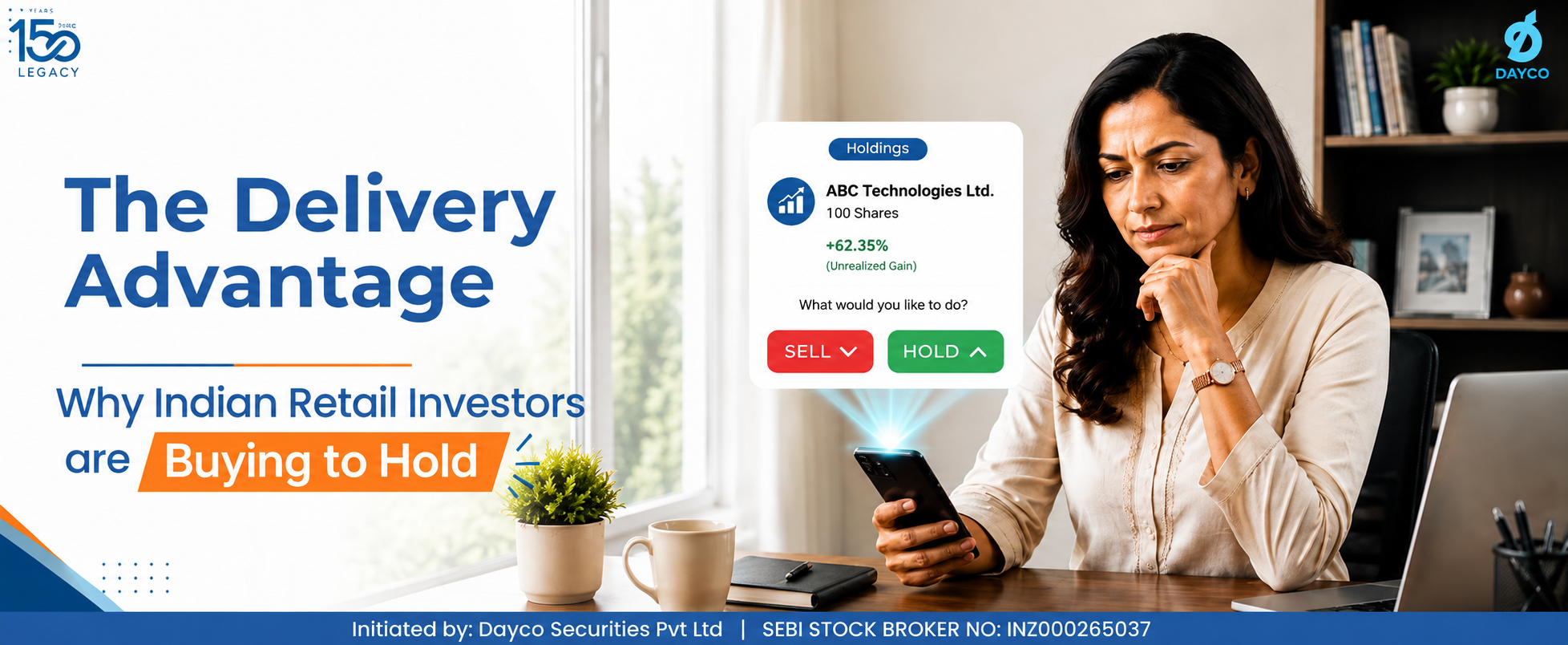
The Delivery Advantage: Why Indian Retail Investors are Buying to Hold
 August 15, 2026
 0 Comments
You have been trading for five years. You don't consider yourself a gambler. You study charts, back-test strategies, hedge your positions and track your trades carefully.
Then you spot what looks like an easy opportunity.
Natural Gas is trading around ₹310. An option with a strike price of ₹400 is still far out of the money. Expiry is only two days away. Historically, Natural Gas has almost never moved from ₹310 to ₹400 in such a short period.
So, you sell the option. It feels safe. The probability looks comfortably in your favour. The premium looks like easy money.
And then the market does what markets do best: it ignores your probability.
In just two days, the trader loses around ₹4.5 lakh.
What makes the story particularly interesting is not that the person was a complete beginner. In his own words, he had been trading for years, had studied his strategy and believed the trade was logical. “It felt safe. It felt logical.”
That is perhaps one of the biggest traps in short-term trading. A trade can look logical, statistically favourable and well-researched — and still produce a devastating loss. For millions of Indian investors, experiences like these have gradually changed how they view the stock market.
The question is no longer simply:
“How quickly can I make money?”
Increasingly, it is becoming:
“How can I stay invested long enough to build wealth?”
And the latest numbers from SEBI’s Annual Report 2025–26 suggest that this change may already be visible in investor behaviour.
The numbers tell an interesting story:
● Delivery-to-Traded Quantity Ratio: Increased from 23.6% in 2024–25 to 29.3% in 2025–26 across clearing corporations.
● Delivery-to-Traded Value Ratio: Increased from 24.4% in 2024–25 to 27.4% in 2025–26 during the same period.
At the same time, futures and options contract volumes declined significantly, with futures volume falling by 17.7% and options contract volume falling by 51.5%.
Taken together, these numbers point to an interesting shift: while speculative activity in derivatives has cooled, a larger proportion of equity trading results in shares actually being taken into delivery.
And that matters. Because taking delivery is fundamentally different from trying to profit from every short-term market movement.
What Does “Taking Delivery” Actually Mean?
When you buy shares with the intention of holding them in your Demat account, rather than selling them within the same trading day, you are taking delivery.
For example, if you buy 50 shares of a company because you believe the business can grow over the next few years, those shares become part of your investment portfolio.
You are not trying to make a quick profit from every price movement. You are giving the investment time to work. That is the basic difference between investing and short-term trading.
And that simple shift — from trying to predict the market tomorrow to participating in the growth of a business over several years — may be one of the most important changes taking place in India's retail investment landscape.
Reasons Behind Investors Circling Back to Delivery Trading
One major reason could be a growing awareness of the risks involved in short-term trading, particularly in the F&O segment.
No matter how many regulatory interventions happen, until people start losing money, they don’t stop bad investment practices.
Last year, SEBI published a damning report revealing that 93 out of 100 investors in the F&O segment lost money in FY22 and FY24. People would lose money once, twice, maybe a couple more times. But there is a limit to their appetite for loss-making.
Then came the timely and much-needed interventions from SEBI:
● Minimum contract value increased from Rs 5 lakh to Rs 15 lakh. And the riskiest thing you could do in F&O – selling Options - the required margin for selling a lot increased prohibitively.
For example, selling a single lot of Nifty would entail around Rs.70,000 in margin before the SEBI intervention. After the intervention, the same margin ballooned to Rs.2 lakh.
● SEBI also slapped an Extreme Loss Margin of 2% on short index options positions near expiry. Remember, expiry days often see volatility causing significant losses to sellers.
What Does This Mean in Simple Terms?
Think of SEBI as the referee in a high-stakes game where amateur players can get hurt. SEBI observed that the number of untrained players was increasing in the high-risk F&O trading market. So, the referee increased the bar to enter the high-risk game.
You can equate raising the contract value with the metaphorical condition in a high-stakes game - “Must be this high, and must weigh this much KG to take part in the game”. SEBI did just that - it made sure that the players taking part in the F&O actually have the appetite to get hurt financially if things don’t go their way.
The message is simple: Higher risk requires greater awareness, preparation and financial capacity.
What This Means for You as an Investor
If you are already an investor - and not a trader - then this SEBI update might feel distant. But this is actually fantastic news for investors like you.
● You can now drop the FOMO
Have you ever felt not so “cool” for not trading or for not using F&O? You can now proudly flaunt your mutual fund gains. All these SEBI interventions point to one fact: people were losing money in short-term trading! The SEBI data gives you, the long-term investor, permission to breathe easy. Slow and steady isn’t just safe - it’s the only proven winning strategy in a market that’s filled with “influencers” and their unauthorised advice.
● You get your time and peace of mind back
For traders who indulged in short-term trading out of FOMO, the higher barrier to entry will push them back to safe investing. Trying to time intraday trading or F&O entails hours of research, high stress and the constant fear of volatility.
Young Indian Investors are Finally Realising - Boring Is Beautiful
The shift towards delivery investing becomes even more interesting when we look at how India's retail investor base has evolved over the past few years.
The massive influx of retail traders into the intraday equity sector was fuelled primarily by young traders entering the market during the Covid era. SEBI data indicate that around 2019, the number of intraday traders hovered at 1.49 million. That number skyrocketed to 7.83 million in FY22. The F&O segment also saw explosive growth during the period (from almost 7 lakhs to 45 lakhs).
For many young investors, the stock market initially appeared to offer an exciting and relatively quick path to wealth. The post-Covid market recovery only reinforced that perception. As markets bounced back sharply from the pandemic-led downturn, many new participants experienced gains soon after entering the market.
But there was a problem.
A market that is going up is not necessarily predictable. As volatility returned and market conditions became more challenging, strategies that had appeared successful during the recovery began producing very different results. Stories of traders losing lakhs of rupees in just a matter of days became increasingly common.
Then came the shift in narrative.
More retail participants began to recognise that short-term trading, particularly in leveraged products such as F&O, comes with risks that are easy to underestimate.
The market does not care how confident you are in your strategy. A trade can look logical, the probability can appear to be in your favour, and the outcome can still go completely against you.
The focus is gradually shifting from:
“How quickly can I make money?” to:
“How can I build wealth over time?”
And that may be one of the healthiest changes happening in India's investment landscape.
The Market Is No Longer a Casino
If the collapse of speculative F&O volumes was the wake-up call, what happened next was the silent revolution. Young Indian investors matured quickly - they did not just sulk. They have stopped treating the market as a casino. The market is now a wealth-building engine for them
The data from the SEBI Annual Report (2025-26) paints a beautiful picture of this maturity:
● Increase in SIP - Systematic investing - the tried and tested method of wealth creation - is getting more and more popular. The number of active SIPs has jumped to 10.45 crore!
● Record Contributions: The average monthly SIP contribution jumped by 25.8%, hitting an astonishing ₹16,413 crore per month.
● Mutual Fund Investor Base Expanding - It expanded to 6.1 crore. And Tier II and Tier III cities are at the forefront of this uptick.
These numbers point towards a broader change. More Indians are becoming comfortable with the idea of investing regularly and staying invested for the long term.
Domestic Investors Are Playing a Bigger Role
Another important development is the growing importance of domestic investors in India's capital markets.
Domestic institutional investors, or DIIs, now have a significant presence in the Indian equity market.
This growing participation provides an important source of domestic capital and, to some extent, reduces the market's dependence on foreign portfolio flows. And when retail investors choose direct stocks, the latest delivery numbers suggest that a larger share of those purchases is being held rather than immediately traded.
According to NSE Clearing Limited's data, the delivery-to-traded quantity ratio increased from 22.6% to 30.2% over the period referenced in the report.
That is a meaningful shift.
In the End: Investing Doesn't Have to Be Exciting
The SEBI annual report is a testament to the resilience of Indian investors - especially the young investors. The stock market will always have its share of excitement. Prices will rise. Prices will fall. New trends will emerge. New investment products will appear.
But successful investing doesn't necessarily require constant action.
Sometimes, the most important decision an investor can make is simply to stay invested, remain disciplined and give investments enough time to grow.
The SEBI Annual Report 2025–26 provides encouraging evidence that Indian investors may be moving in this direction. The rise in delivery-based investing, SIP participation, and mutual fund investor numbers suggests that more people are thinking beyond short-term market movements.
And perhaps the biggest lesson is this:
You don't have to beat the market every day to build wealth.
You need a suitable investment strategy, patience, discipline and the ability to stay focused on your financial goals.
In investing, boring can be beautiful — because wealth creation is often about time, not timing.
-Sukalyan Halder & Marifur Rahaman
Share With


 FILED UNDER: Stock Market
I'm a cool paragraph that lives inside of an even cooler modal. Wins!
Are you sure?
In case you didnt know, you can open your account online within 24 hours. Offline account opening takes up to 4 working days. If you wish to open your account offline, fill and sign the forms using a black/blue ballpoint pen. Please fill in the email and mobile number of the applicant to avoid account opening delays.
Enter Password
Please enter your details and password
New to Dayco?
Enter Password
Please enter your details and password
New to Dayco?
Filing Complaints on SCORES (SEBI) – Easy & Quick
- Register on SCORES Portal (SEBI)
- Mandatory details for filing complaints on SCORES:
- Name, PAN, Address, Mobile Number, E-mail ID
- Benifits:
- Effective Communication
- Speedy redressal of the grievances
Thanks !!
Your details were successfully received.

Thank you for Your Feedback!
Our Team is working constantly on improving our user experience and your feedback really means a lot.
Thanks !!
App Link Send to your mobile number successfully.
Thank You
All your Questions have been recorded
Thank You
All your Questions have been recorded
Thank You!
Thank you for your response. We'll get in touch with you at the earlisest for your investment planning needs
NEXT
Thank You!
Thank You for your interest in our Moderate Equity Portfolio. Please find below the credentials to track this portfolio:
User ID: mockmod@daycoindia.com
Password: abcd@1234
Portfolio Tracker
Please Read!
Risk profiling is crucial for identifying and managing potential risks in investment decisions. Please carry out your risk profiling before making any investment decisions.
Complete Risk Assessment Now
Thank You !!
Please enter your details to download/print the report
Thank You !!
Please enter your details to download/print the report
Thank You !!
Please enter your details to download/print the report
Thank You !!
Please enter your details to download/print the report
Thank You !!
Please enter your details to download/print the report


Set Your Goal
Please Select an option from below
Set Your Goal
Please Select an option from below
Thanks You !
We appreciate your interest in our services. Our team will be in touch with you shortly.
CloseSet your Goal
Please enter your details in the fields provided
Thanks You!!
Calculation report has been sent to your mail id successfully
Clear form?
This will remove your answers from all questions and cannot be undone.
Leave a Reply