Quality Investing in Uncertain Markets: Why Strong Balance Sheets Matter More Than Ever

May 15, 2026

0 Comments

Quality Investing in Uncertain Markets: Why Strong Balance Sheets Matter More Than Ever
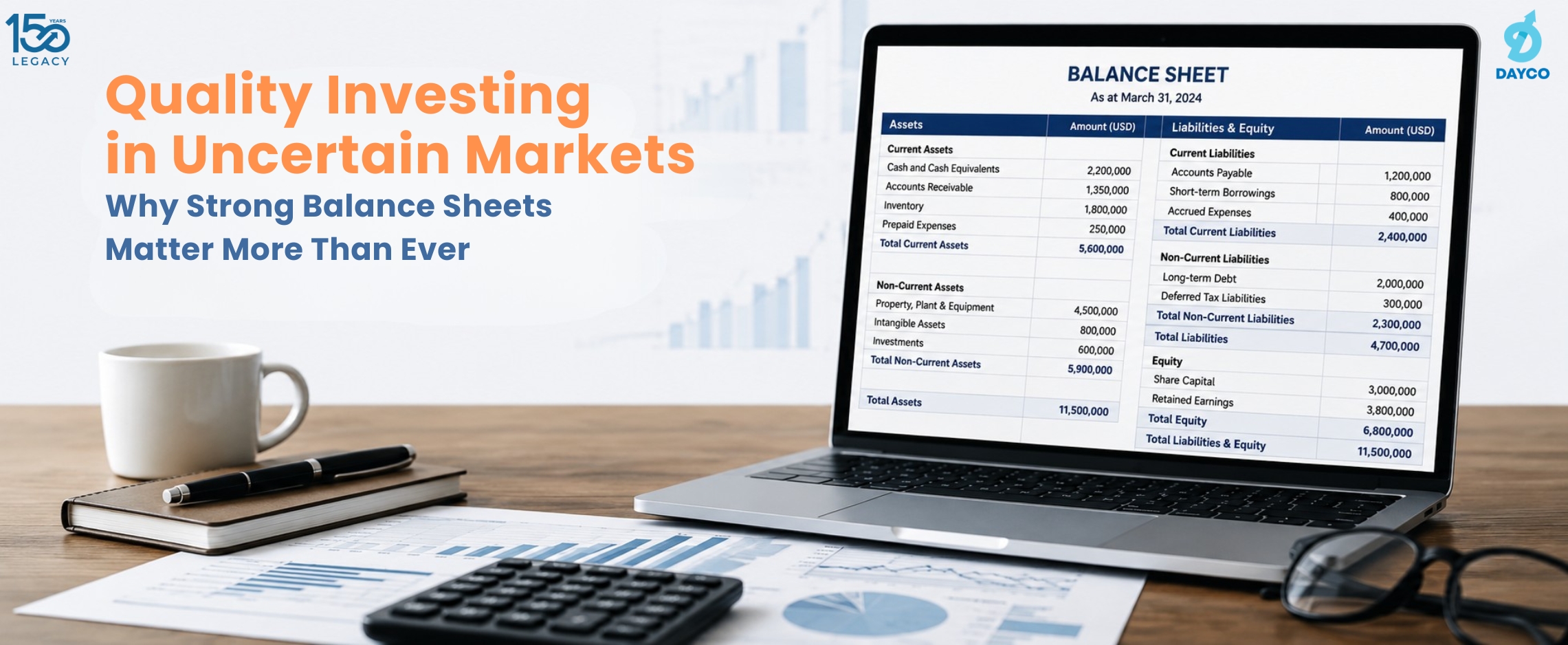
How do you keep your portfolio resilient when the markets around you seem to be in chaos? From local geopolitical tensions to unexpected fluctuations in interest rates along with economic pressure - investors have been on the edge lately. For example, the sudden geopolitical crisis in the Middle East caused the stock prices of oil companies to rise high. Suddenly oil stocks looked more attractive than paint stocks (producing paint products needs petroleum), which nosedived in February and March. This means you no longer can depend on short-term speculation to secure consistent returns in this environment. To truly insulate your investments, it is time to embrace quality investing, where a robust balance sheet is the most reliable measure of a company's endurance.

Decoding the “Quality” Metric in Quality Investing

During market swings, the term 'quality' is often used to hint at large-cap companies or household names. But true quality isn’t just about being a blue-chip or large-cap company. We can quantify quality in the Indian stock market. How?

In India, we already have objective benchmarks like the Nifty 200 Quality 30 index. The process through which stocks are included in this index gives us a clear picture of what “quality” means.

This index systematically strips away market noise and identifies resilient stocks based on three uncompromising pillars deeply tied to balance sheet strength:

● Debt-to-Equity (D/E) Ratio (The Shield): This is the ultimate measurement metric of how sustainable a company is. 

It shows how much short-term and long-term debt a company has in its balance sheet and how much money can be returned to shareholders if the company liquidates all the assets and pays off all the debts.

In an environment of unpredictable interest rates or sudden economic pressures, a low D/E ratio signifies a company that is funding its own growth rather than being choked by debt-servicing obligations.

● Return on Equity (Efficiency Metric): Quality doesn’t mean playing safe. This metric shows how efficiently a company uses shareholders’ money to generate profits. 

So, on one hand, you have low debt. And if high Return on Equity is added to it, the company is thought to be a self-sustaining business. The stock might face temporary hiccups during macroeconomic headwinds – but it will be temporary.

● Earnings Per Share Growth (Growth Metric):  Now, how do you prove that a company is consistently profitable and growing its shareholder value? That’s where Earnings Per Share (EPS) (shown as Retained Earnings in the balance sheet) comes in.

EPS is calculated from the company’s Profit & Loss statement, and it reflects how much profit the company generates per share outstanding.

If a company’s EPS grows steadily over several years, it’s a strong sign that the business is healthy, efficient, and has the ability to generate sustainable profits — even when market conditions become uncertain.

Quick Guide: Spotting Quality on the Balance Sheet


Bonus Valuation Check (After Balance Sheet Quality)

Once you shortlist companies with strong balance sheets, the next step is to ensure you are not overpaying for them. That is where valuation and volatility indicators become useful.

● P/B Ratio (Price-to-Book Ratio): This tells whether the stock price is trading at a premium or discount compared to its net worth (book value).

A very high P/B could indicate the market is already pricing in future growth aggressively, while a reasonable P/B gives investors a margin of safety.

● P/E Ratio (Price-to-Earnings Ratio): This helps evaluate whether the stock price is justified compared to its earnings.

Even the best company can become a poor investment if purchased at an extremely inflated P/E valuation.

● Beta (Volatility Indicator): Beta measures how much the stock tends to move compared to the broader market.

During uncertain markets, low-beta stocks usually show lower volatility, which makes them more stable for long-term investors during panic-driven corrections.

But What Balance Sheet Items to Look at When There Is a Sudden, Jarring Economic or Geopolitical Event

When a sudden economic event occurs, companies face immediate liquidity concerns. While D/E ratio, RoE and EPS are great for measuring a stock’s long-term quality, they fall short when it comes to judging a company’s power of handling an immediate crisis. This is where these two balance sheet items come into play:

● Cash and Cash Equivalents:  

This balance sheet line item shows how much cash a company has to absorb an immediate crisis. During a sudden, unexpected crisis, a cash-rich company won’t need to panic-borrow at exorbitant rates. More importantly, it allows a resilient business to play offence during a crisis - using its war chest to acquire struggling competitors at a steep discount or capture new market share while heavily leveraged peers are forced to downsize.

● Current Ratio:

While long-term debt is evaluated by the D/E ratio, the Current Ratio focuses strictly on a company's obligations over the next 12 months. This balance sheet item shows whether a company can survive immediate jarring economic shocks without facing insolvency or liquidating core assets. 

Conclusion: Build on Bedrock, Not Speculation

You cannot control macroeconomic headwinds, geopolitical turmoil or sudden interest rate hikes. But you can build a strong foundation for your portfolio. Instead of playing musical chairs in the stock market, if stocks are picked with absolute surgical precision - aided by balance sheet data - you get a portfolio that remains resilient. Quality investing, anchored by fortress balance sheets, builds your portfolio on bedrock. When the market panics, you don't have to guess if your holdings will survive. 

Let the Ocean Remain Chaotic. Just Build a Fundamentally Resilient Ship.

-Sukalyan Halder & Marifur Rahaman

Share With

Leave a Reply

This is a standard alert.

I'm a cool paragraph that lives inside of an even cooler modal. Wins!

This is a standard alert.

I'm a cool paragraph that lives inside of an even cooler modal. Wins!

https://scores.gov.in

Thank You

All your Questions have been recorded


Thank You

All your Questions have been recorded

Please enter your name Please enter valid name
Please enter your Email Id Please enter valid Email Id
Please enter your mobile number Please enter valid mobile number Please enter your mobile number Please enter valid mobile number
Please enter your Email Please enter valid Email

Thank You!


Thank you for your response. We'll get in touch with you at the earlisest for your investment planning needs


NEXT

Thank You!


Thank You for your interest in our Moderate Equity Portfolio. Please find below the credentials to track this portfolio:

User ID: mockmod@daycoindia.com

Password: abcd@1234


Portfolio Tracker

Please Read!


Risk profiling is crucial for identifying and managing potential risks in investment decisions. Please carry out your risk profiling before making any investment decisions.


Complete Risk Assessment Now

Set Your Goal

Please Select an option from below


Set Your Goal

Please Select an option from below


Set your Goal

Please enter your details in the fields provided

Please enter phone number / UGC