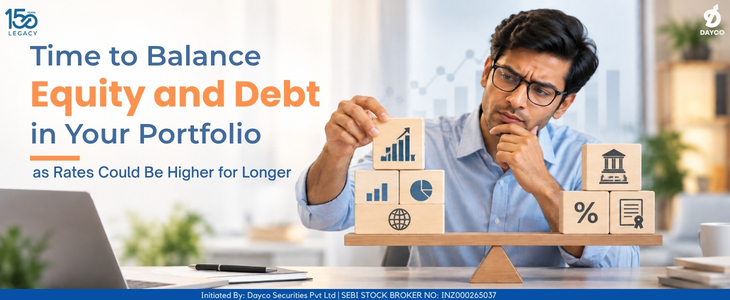
Time to Balance Equity and Debt in Your Portfolio as Rates Could Be Higher for Longer?

September 30, 2026

0 Comments

Time to Balance Equity and Debt in Your Portfolio as Rates Could Be Higher for Longer?
Indian investors have been waiting for an easing of interest rates for most of the last two years. It could get more complicated for them now. The retail inflation rate has gone up to its highest level in 20 months, while the yield on 10-year government securities has crossed the 7% mark. Globally too, bond yields have hardened. A growing number of economists do not think the Reserve Bank of India would be in a hurry to cut rates anytime soon. This story of rates being higher for longer has important implications for people who create wealth using equity and debt.

Why Higher Rates Make a Difference

When returns on relatively low-risk investments such as fixed deposits, government securities, and high-quality debt mutual funds rise, investors may expect greater compensation for taking on the additional risk associated with equities.
Higher interest rates can also affect how investors value companies, particularly high-growth businesses whose expected profits lie further in the future. When interest rates rise, those future earnings may be valued less favourably, which can put pressure on some equity valuations.
In addition, higher borrowing costs can affect corporate profitability. Companies with high debt, long investment gestation periods, or limited pricing power may face greater pressure on their margins. Real estate, automobiles, consumer durables, and capital-intensive sectors such as infrastructure can be more sensitive to borrowing costs.

Equities: Stay Invested but Choose Your Stocks

It is natural to consider reducing equity exposure when interest rates rise. However, long-term investors should avoid making major portfolio decisions based solely on short-term changes in interest rates.

Instead, focus on the quality of the businesses you own. Companies with strong balance sheets, manageable leverage, healthy free cash flows, and pricing power may be relatively better positioned to handle higher borrowing and operating costs.

A diversified equity portfolio can include large-cap companies, with appropriate exposure to mid- and small-cap companies, depending on the investor's risk profile and time horizon. Investors should also be cautious about excessive concentration in a particular theme or sector.
For investors using SIPs, market volatility does not necessarily mean that contributions should be stopped. Continuing investments in line with the financial plan allows investors to purchase more units when market prices are lower.

Debt: Align Investments with Your Time Horizon

Debt investments require a different approach because interest-rate movements affect different instruments in different ways.

Bond yield is the return an investor earns from a bond, while bond price is the amount at which the bond is bought or sold in the market. They generally move in opposite directions. When market interest rates rise, new bonds offer higher yields, making existing bonds with lower yields less attractive, so their prices tend to fall. When interest rates fall, existing bonds become relatively more attractive, so their prices tend to rise.
When interest rates rise, fresh investments in debt instruments can eventually benefit as new investments are made at higher interest rates. However, existing debt investments, particularly those with longer durations, can experience price volatility.

Short- to medium-term investments such as liquid funds, money market funds, floating-rate funds, and highly rated corporate bonds with shorter maturities generally have lower sensitivity to changes in interest rates than long-duration funds.

When yields rise, bond prices generally fall, which can affect the NAV of longer-duration debt funds. Therefore, investors with shorter investment horizons may prefer to avoid taking unnecessary duration risk. For longer-term investors, duration should be considered in the context of their investment horizon and overall financial plan, rather than predicting the exact peak or bottom of interest rates.

Another factor to consider is credit quality. Investors should not chase higher yields without understanding the additional credit risk involved. Financially weaker companies can face greater pressure when borrowing costs rise, increasing the risk associated with lower-rated debt.

Should You Rebalance?

Rebalancing does not necessarily mean moving away from equity because interest rates are rising. Instead, it means bringing the portfolio back to the originally selected asset allocation based on the investor's goals, time horizon, and risk tolerance.

For example, suppose an investor initially decides to maintain a 60% equity and 40% debt allocation. If market movements cause the portfolio to shift to 70% equity and 30% debt, the investor can review the portfolio and rebalance it towards the intended allocation.

The objective is not to predict whether equity or debt will perform better next. It is to ensure that the portfolio continues to reflect the investor's financial plan.

Therefore, interest-rate cycles should not automatically prompt tactical changes to the portfolio. Within each asset class, however, investors should continue to pay attention to quality, valuation, credit risk, and duration.

Don't Ignore Your Liabilities

A period of higher interest rates is also a good time to review your liabilities.

If you have a variable-rate home loan, review how changes in interest rates are affecting your borrowing cost. If you have surplus cash, consider whether making a partial repayment is appropriate for your financial situation.

At the same time, avoid taking on additional high-cost debt unless necessary and consistent with your overall financial plan.

The Bottom Line

Higher interest rates do not automatically mean that investors need to radically restructure their portfolios. They highlight the importance of having the right asset allocation and maintaining discipline through different market cycles.

Build your portfolio around your financial goals, investment horizon, and risk tolerance. Diversify across equity and debt as appropriate, maintain adequate liquidity for emergencies, focus on quality rather than simply chasing higher yields, and review your asset allocation periodically.

Markets will continue to move through different interest-rate cycles. A well-defined financial plan can help investors make portfolio decisions based on their own objectives rather than reacting to every change in market news.

-Anuj Singh

Share With

Leave a Reply

This is a standard alert.

I'm a cool paragraph that lives inside of an even cooler modal. Wins!

This is a standard alert.

I'm a cool paragraph that lives inside of an even cooler modal. Wins!

https://scores.gov.in

Thank You

All your Questions have been recorded


Thank You

All your Questions have been recorded

Please enter your name Please enter valid name
Please enter your Email Id Please enter valid Email Id
Please enter your mobile number Please enter valid mobile number Please enter your mobile number Please enter valid mobile number
Please enter your Email Please enter valid Email

Thank You!


Thank you for your response. We'll get in touch with you at the earlisest for your investment planning needs


NEXT

Thank You!


Thank You for your interest in our Moderate Equity Portfolio. Please find below the credentials to track this portfolio:

User ID: mockmod@daycoindia.com

Password: abcd@1234


Portfolio Tracker

Please Read!


Risk profiling is crucial for identifying and managing potential risks in investment decisions. Please carry out your risk profiling before making any investment decisions.


Complete Risk Assessment Now

Set Your Goal

Please Select an option from below


Set Your Goal

Please Select an option from below


Set your Goal

Please enter your details in the fields provided

Please enter phone number / UGC