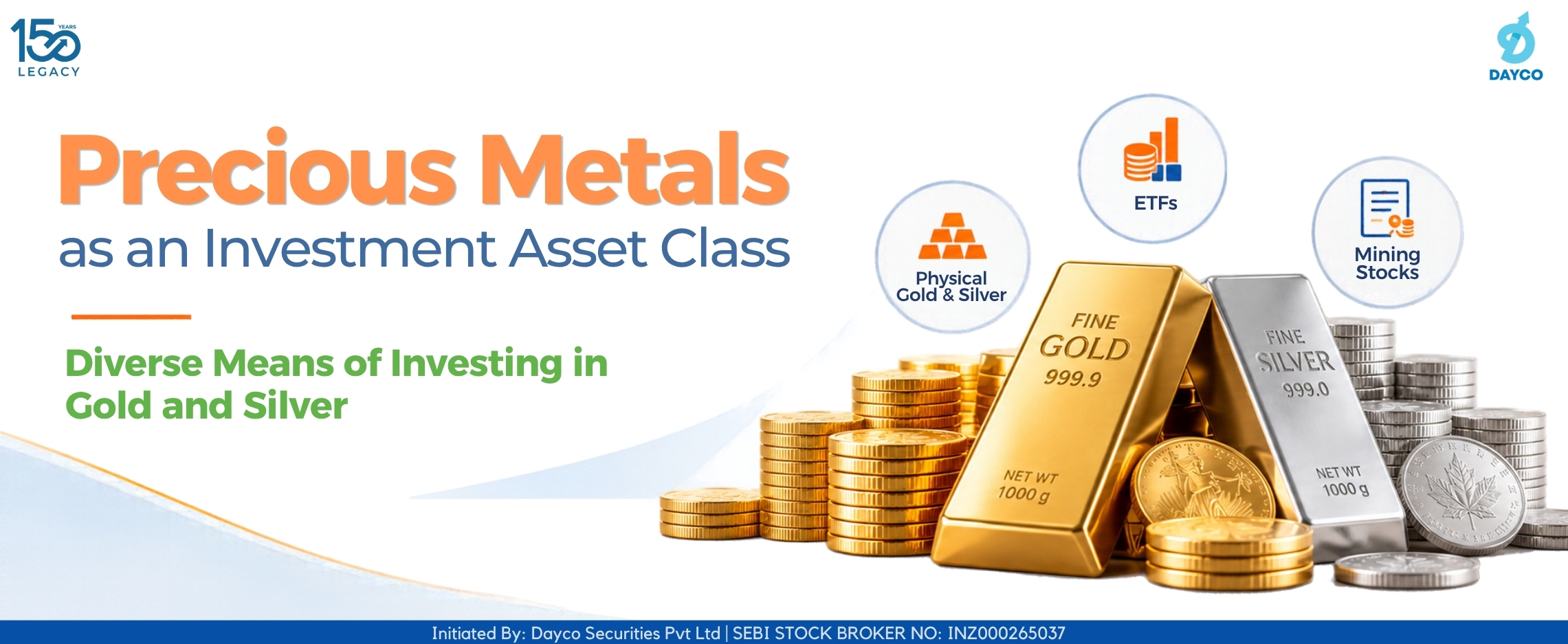
Precious Metals as an Investment Asset Class: Diverse Means of Investing in Gold and Silver

October 17, 2026

0 Comments

Precious Metals as an Investment Asset Class: Diverse Means of Investing in Gold and Silver
Gold and silver have traditionally been valued for jewellery, gifting and cultural purposes. Today, they are also considered investment assets that may help diversify a portfolio. Investors can choose from physical metals, exchange-traded funds (ETFs), mutual funds and other options, each with different costs, risks and features.

According to the World Gold Council, India's investment demand for gold rose 54% year-on-year to 82 tonnes in the first quarter of 2026. Jewellery accounted for around 30% of total gold demand, its lowest share in the Council's data series dating back to 2000.

Gold may help diversify a portfolio, while silver's industrial and investment demand can increase price volatility. Neither metal guarantees return or protects investors from losses. The right investment method depends on individual financial goals, risk tolerance and investment horizon.

For investors, therefore, the question is not simply whether to invest in precious metals, but how to access them in a manner suited to their financial goals, risk tolerance and overall asset allocation.

Physical Metals and Their Hidden Expenses

Buying physical gold and silver remains a familiar choice, especially for jewellery, gifts and occasions such as weddings. Coins and bars may suit people who want to own the metal for investment, but physical purchases still involve costs and practical considerations.

When buying physical gold or silver, 3% GST applies to the purchase. Jewellery also carries making charges, which increase the initial cost. GST on retail jewellery is charged at 3% of the total transaction value, including making charges, even when they are shown separately. These additional costs can make jewellery less suitable for investors whose primary goal is to benefit from changes in metal prices.

Physical metals also need safe storage and protection against theft. Before buying, compare the total purchase price, purity, applicable taxes and likely resale value. Jewellery may be appropriate when the goal is to wear or gift it, while coins and bars may be worth considering when physical ownership itself is important.

Gold and Silver ETFs: A Market-Linked Option

Gold and silver ETFs are traded on stock exchanges such as the NSE and BSE. They invest in physical gold or silver to track the respective metal's price, subject to expenses and tracking differences. They allow investors to gain exposure without personally storing the metal.

Investors generally need a demat and trading account to buy and sell ETF units. Unlike physical jewellery, ETFs do not involve jewellery-making charges or the direct 3% GST applicable to physical metal purchases. However, brokerage, fund expenses, bid-ask spreads and liquidity should be considered. ETF market prices may also differ from their underlying NAV.
Expense ratios vary by scheme, so investors should compare current scheme documents rather than rely on a fixed range. Under the applicable tax rules, listed gold and silver ETF units held for more than 12 months generally qualify as long-term capital assets, with long-term gains generally taxed at 12.5% without indexation. Gains on units held for 12 months or less are generally taxed at the applicable income-tax slab rate. Investors should verify the current tax provisions before investing or selling.

Gold can help diversify a portfolio, but its price can fall, and it does not always move opposite to equities. Silver is influenced by both industrial demand and investment sentiment and can experience sharper price movements. It should not automatically be treated as a defensive asset.

As of 16 October 2026, several large mutual fund houses, including HDFC, Kotak Mahindra and UTI Mutual Fund, may have temporarily suspended bulk subscriptions to their gold  ETFs ahead of the festive season. The fund houses have not stated a reason or an end date. With fewer new units being created, an ETF’s exchange price can trade at a premium to its NAV during periods of high demand, so investors should compare the two before buying.

Funds of Funds, Electronic Gold Receipts and Sovereign Gold Bonds

Gold and Silver Funds of Funds

A Fund of Funds (FoF) invests in other funds, such as gold or silver ETFs. It may suit investors who prefer investing through a mutual fund rather than buying ETF units directly. Some schemes offer SIP facilities.

FoFs are generally bought or redeemed at the applicable end-of-day NAV rather than at live exchange prices. They may also involve an additional layer of expenses. Check the scheme's costs, investment options and tax treatment before investing.

However, as of mid-October 2026, several gold FoFs may have temporarily stopped accepting new SIP registrations, lump-sum investments and switch-ins. Some may have also stopped increases to existing SIP amounts, so check the scheme’s current status first.

Electronic Gold Receipts (EGRs)

Electronic Gold Receipts represent ownership of physical gold held in approved vaults. They can be held in a demat account and traded on an exchange, subject to available products and exchange rules. EGRs currently relate to gold, not silver.

Investors should check the receipt's denomination, purity, trading liquidity, charges and requirements for converting it into physical gold. Market access and conversion facilities may vary.
 
Sovereign Gold Bonds (SGBs)

Sovereign Gold Bonds are government securities linked to gold prices and carry specific tenure and interest terms.

New issuances have been paused since 2024, although existing bonds may be available on the secondary market, depending on listings and liquidity. Their market price may differ from the value implied by gold prices.

Before investing, check the remaining maturity, interest terms, purchase price and tax treatment. Tax rules may differ depending on when the bond was acquired and whether it is redeemed or sold in the secondary marke.

At a Glance: Comparing the Investment Options


No single option is best for every investor. The right choice depends on whether the goal is to own jewellery, gain investment exposure to gold or silver, invest regularly, or hold an instrument for a particular period.

[Note: Subscription availability for gold ETFs and FoFs can be temporarily restricted by fund houses. Check the latest scheme notices before investing.]

Choosing with Discipline

Which route to follow depends on the objective. For a wedding or personal use, physical gold may be the practical choice because the metal or jewellery is needed. For portfolio diversification, ETFs or mutual fund schemes may offer a more convenient way to gain exposure without storing physical metal. EGRs and SGBs have their own features and may suit investors who understand their specific rules, liquidity and holding periods.

The appropriate allocation depends on financial goals, investment horizon, risk tolerance and the rest of the portfolio. Precious metals can help diversify investments, but they do not guarantee protection from equity losses or outperform other assets consistently.

Lump Sum or Regular Investing?

Investors can purchase precious metals in a lump sum or invest regularly through an SIP where the chosen product permits it. Regular investing spreads purchases across different price levels and reduces dependence on a single entry point.

However, SIPs do not guarantee higher returns or prevent losses. Outcomes depend on purchase prices, investment duration and costs. Investors should avoid making decisions solely because metal prices have recently risen.
Product availability can also change. Under the current restrictions, existing SIPs continue to be processed at the applicable NAV, and redemptions continue as usual. However, new SIP registrations or increases to SIP amounts may not be accepted until the restriction is lifted.

Conclusion

Gold and silver offer different ways to diversify investments, but each method has its own costs, risks and conditions. Physical metals provide direct ownership, while ETFs and FoFs offer market-linked exposure through financial products. EGRs and SGBs have their own regulatory, liquidity and operational considerations.

Before investing, compare the costs, risks, tax treatment and holding requirements of each option. The aim is to choose a suitable investment method and allocation that align with your financial goals and risk tolerance.

-Sukalyan Halder and Anuj Singh

Share With

Leave a Reply

This is a standard alert.

I'm a cool paragraph that lives inside of an even cooler modal. Wins!

This is a standard alert.

I'm a cool paragraph that lives inside of an even cooler modal. Wins!

https://scores.gov.in

Thank You

All your Questions have been recorded


Thank You

All your Questions have been recorded

Please enter your name Please enter valid name
Please enter your Email Id Please enter valid Email Id
Please enter your mobile number Please enter valid mobile number Please enter your mobile number Please enter valid mobile number
Please enter your Email Please enter valid Email

Thank You!


Thank you for your response. We'll get in touch with you at the earlisest for your investment planning needs


NEXT

Thank You!


Thank You for your interest in our Moderate Equity Portfolio. Please find below the credentials to track this portfolio:

User ID: mockmod@daycoindia.com

Password: abcd@1234


Portfolio Tracker

Please Read!


Risk profiling is crucial for identifying and managing potential risks in investment decisions. Please carry out your risk profiling before making any investment decisions.


Complete Risk Assessment Now

Set Your Goal

Please Select an option from below


Set Your Goal

Please Select an option from below


Set your Goal

Please enter your details in the fields provided

Please enter phone number / UGC